The Ten Commandments
Still The Best Moral Code
By Dennis Prager
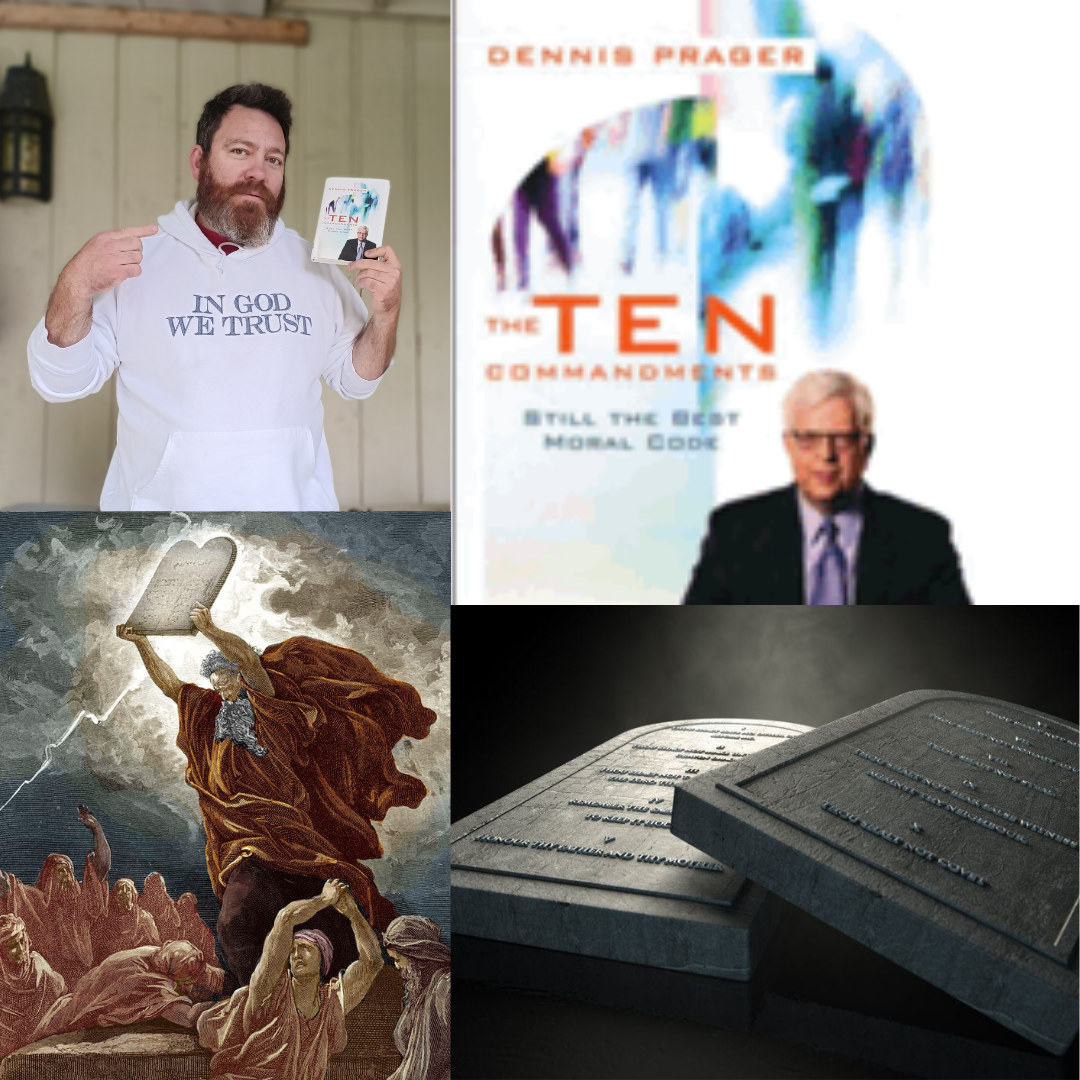
I recently read “The Ten Commandments: Still the Best Moral Code” by Dennis Prager. I wanted to read this book to start to learn a little more about the Ten Commandments. As a Christian I have heard many people say that Old Testament laws do not apply to Christians. This often led to believe that there was nothing of value and nothing worth studying in the Old Testament. And yet, the Ten Commandments used to play a prominent role in America. They were posted in our courthouses and many of our schools. Much of our legal code can be traced back to this seemingly simple and straightforward code. The Ten Commandments are given in their entirety twice in the Bible. The 4th Commandment on keeping the Sabbath is repeated so many times, I lost count and gave up trying to keep track. Any time God repeats Himself, it’s for our benefit so we should take note.
Dennis Prager is a practicing Jew who spent 25 years teaching the Torah. For many years, he also hosted a show that brought together ministers of various religions: Catholics, many forms of Protestants, Muslims, Buddhists, Jewish Rabbis and others. Because of this background, Dennis has a unique perspective on this Biblical moral code. Below is my summary and review of what Dennis has written. I have tried to specifically note where I have injected my own personal opinions. You can safely assume that any errors or inaccuracies contained in this article are entirely my own.
Why have the Ten Commandments?
“We Live in a world filled with evil and moral confusion. There is only one way out: affirmation of a God Whose primary demand is that we treat our fellow human beings decently… That is why the Ten Commandments are the most important thing ever written.”
Dennis Prager
Different people believe different things. Some argue that humankind is ever evolving, ever improving. But the 20th century was the bloodiest century in human history where mankind invented new ways of killing our fellow man and continues to inflict terrible suffering on each other. In America we are largely spared from the kind of devastating conflict and endless war that plagues much of the rest of the planet. Even if we do see some refugees moving into our cities, we are just barely getting a glimpse of the peak of the iceberg of human suffering.
Of course, we don’t have to look to war torn nations to see that without a moral code over all of us, we would be left with nothing but our opinions and those with the most power would determine what was right. We need a universal moral code, that applies to all humans equally. In Prager’s view, the Ten Commandments is the best moral code mankind has received in 3,000 years and no one will ever come up with a better one.
Where do we start?
There is a difference in the way Christians and Jews count the Ten Commandments. The first difference is that the Jews call it the Ten Statements rather than commandments. I think this is a vitally important difference that we Christians should thoughtfully consider and learn from. In my opinion, many of us Christians (and non-Christians) have viewed the Ten Commandments as coming from a finger wagging, fun hating “Man Upstairs” Who wants Christians to miss out on the good life by living quiet boring, do-nothing lives. This view could not be further from the truth. Viewing these as the Ten Statements, as Dennis does, and taking a look at the historical context in which they were given, we can start to see a much clearer and more accurate view of God:
- A mighty God Who had just liberated His people from slavery
- A people with no identity who had been uprooted from the only place they had ever known
- A people who were no doubt bewildered and facing a wide open world of opportunity where freedom was both a blessing and a terrifying reality
In three thousand years, no one has ever come up with a better system than the God-based Ten Commandments for making a better world. And no one ever will.
Dennis Prager (emphasis mine)
Their freedom loving God, who wanted them to stay free offers them a moral code that will help them maintain their new-found freedom. No finger-wagging here, this is God’s Ten steps to living a free and happy life. This is an explanation of life as it really is. It is as if God is saying “If you want to be successful at this, here’s what you need to do.” These are the statements of a God who dearly loves his people and wants them to live long and happy lives. None of the commandments or statements are about what God needs from us. Instead, they all impact how we are to treat others. God cares a great deal about how we treat our fellow humans.
With that understanding, let’s look at the Ten Statements.
1. I am the LORD your God, who brought you out of Egypt, out of the house of bondage
This is the key statement that provides the foundation for the other nine. None of the other statements make sense without this one. First, it tells us these are God’s statements. By identifying himself in this first statement, God is claiming authority and authorship of everything else He is about to say. These statements were not from Moses nor a collection of rabbis exiled in Babylon, but from God Himself. Second, God is the one Who delivered the people of Israel out of Egypt. The people’s freedom came from God, not from themselves, not from Moses, only from God.
Note that God states freedom as the reason why people should follow the Ten commandments. He could have said “I made the entire world; therefore, you need to obey me.” He could have said “I have the power to kill you if you disobey, so you need to obey me.” Instead, God says “I set you free. Live this way, so that you can stay free.” As Dennis Prager says “Freedom comes from moral self-control. There is no other way to achieve it.”
2. You shall have no other gods before me.
People of the ancient world worshiped numerous gods for sun, rain, and fertility. There was a god for every aspect of life. Worship of these gods was largely, if not totally, self-focused or at least selfishly motivated. If you wanted a child, sacrifice to the god or goddess of fertility. Crops dying in a drought? Sacrifice to the rain god. Almost no one does this in America these days, so is this commandment still even applicable or necessary?
Dennis’ answer is that while we may not worship in the same way the ancients did, we still have gods we worship. Money, education, sex, love, comfort, and safety can all be gods in our lives. If any of these gods were to create our moral code, our morals would change based on the outcome of our actions. Dennis gives this example: if we worship the god of love and found ourselves in a hypothetical situation where we could save the drowning dog that we love or an unknown human stranger, we would save the dog that we love, because we worship our own love. Likewise, unspeakable acts of evil and violence have been committed in the name of love of country.
Having one God over all humanity, one God above all other gods, makes all humans equal. We all share a common creator. We were all created in His image. No one person is intrinsically better than anyone else.
In my opinion, we all act like god’s now, determining our own moral code and condemning anyone who disagrees. This is the rotten heart of our toxic culture. Where there is any discussion of morals at all, it is almost always toxic and usually avoided all together.
3. Don’t misuse God’s name.
The Hebrew literally reads don’t “carry” God’s name in vain. This is the only commandment where God says He will not forgive us if we violate it. Numbers 20:7 in the English Standard Version states: “You shall not take the name of the LORD your God in vain, for the LORD will not hold him guiltless who takes his name in vain.”
Given the kinds of atrocities God is willing to forgive (and the Bible show’s God forgiving some terrible sins, far worse sins than I’m sure you or I would ever commit) this seems quite jarring. God could forgive thievery, adultery, and murder, but not a slip of the tongue? Could a casual expression of how hard my day at work was really lead to an eternity without God’s forgiveness? Since this interpretation does not fit with the entirety of God’s character, Dennis and I think we should consider a different interpretation of this commandment. Prager explains carrying God’s name in vain means doing evil in God’s name. The crusaders slaughtering innocent women and children in God’s name comes to mind. More recently we have been saddened and shocked to see several well-known names in Evangelicalism engage in evil in God’s name. This is the most jarring and shocking kind of evil because it is done in the name of the One who condemns the evildoer. And it is not surprising that a just and loving God does not let this kind of evil go unpunished.
4. Remember the Sabbath
I don’t have any statistics to back this up, but I think this is one of the most often repeated commandment. You cannot read the Biblical books of Numbers, Leviticus, and Deuteronomy without hearing this repeated time and again. Like most of God’s commands, we should not be lulled into complacency by the apparent simplicity of this commandment. First, this commandment equalized human beings. Every single person was supposed to take the day off. Dennis makes clear, this effectively ended slavery. The Israelites did not get a day off while they were slaves in Egypt. But God wanted them to live in freedom, not slavery. Everybody got a day off.
Animals also got a day off. This elevated common beasts of burden to beings that mankind should treat animals with dignity, not just as things to be exploited for personal profit.
Finally, this command elevated the family. Since men must take a day off, they are likely to spend more time with their families, which leads us to the Fifth commandment.
5. Honor your Father and Mother
This is the first and only commandment with a promise – “that your days may be long in the land that the LORD your God is giving you.” (Numbers 20:12b ESV) The promise is also a reason. If you honor your father and mother, you will live long in the land your God is giving you. Remember, God is giving these commandments so that the people of Israel can live in freedom in the land God has promised them. If children honor their parents, a society flourishes. Likewise, any society is doomed to self-destruction if children are not taught to honor their Mom and Dad. Many parents fail in this responsibility because we would rather be loved than honored. We would rather be our child’s friend than an authority figure. But if we do this, we fail our children. Children need their Mom and Dad to be loving authority figures. In my opinion, it’s kind of weird for a 40-year-old man to be friends with a 7-year-old girl, but absolutely fitting for that same man to be a loving authority figure who teaches that girl to honor her father and mother.
On a personal note, I will add that one thing that really grinds my gears, is when I see other men shirking their responsibility in teaching their kids to honor their mother. When your child talks back or in any other way shows disrespect to his or her mother, you as the Dad, need to come down HARD on that kind of behavior. There should be no confusion whatsoever in your child’s mind about whether or not it’s okay to be disrespectful to Mom. This is not only the loving thing to do for your wife, but also the loving thing to do for your child. The statistics don’t lie. Children without fathers are far more likely to commit violent crime, go to prison or get pregnant as a teenager before marriage. As a dad, one of the best things you can do to build a better future for your kids and for society, is to teach your kids to respect you and their mother.
6. Do Not Murder
Just like English, Hebrew has different words for kill and murder. The word used here is the Hebrew word for murder. Killing is taking a life, whether the act is moral or immoral. When you swat a mosquito, we don’t accuse you of murder. There are some cases where killing another human being is the moral action to take. If someone is about to stab another person to death and someone shoots and kills them, that is not murder. Acting out in rage and stabbing someone to death with a knife because that person said something you don’t like is murder. Not all killing is murder.
7. Do Not Commit Adultery
This commandment is about protecting civilization. It is that important. Mother, Father, and kids are the fundamental building block of society. This is why so many Hebraic laws are focused on protecting the family. Marriage is the most important relationship in a family and adultery destroys marriage through deception, refocusing energy, love and attention outside of where it is needed most, in the family. There is no caveat in this commandment that allows adultery if husband and wife both agree. Adultery causes damage to the institution of marriage and is prohibited without exception.
8. Do Not Steal
I always thought this was the most straightforward commandment. Do not steal. Reading this book, I realized that I always added one word to this commandment: “Stuff.” The commandment does not read “Do not steal stuff.” I suspect I’m not the only one to add this helpful clarification to the command. But, when you strip away what we add to it, we can start to see what a wide-ranging affect this would have on our lives and our society if we actually obeyed God in just this one command. In fact, Dennis states that you could argue that most, if not all the other commands are summarized in this one. Think about it: What is murder but stealing innocent life? Adultery is stealing another’s spouse. Lying is stealing justice and honesty. Slavery is stealing another human being. So here, in Yahweh’s initial revelation of His good and perfect law, slavery is rendered obsolete.
Prager goes on to show how complete and total this command is with respect to governing how we treat other people by listing various ways in which we can steal from others. We can steal a person’s reputation by slandering them or gossiping about them. We can steal someone’s dignity by humiliating them and we can steal people’s trust by deceiving them. Imagine if everyone obeyed just this one commandment. Move over John Lennon.
9. Do Not Bear False Witness
It is virtually impossible, in fact it very well could be utterly impossible, to have a healthy functioning society where truth is shunned and lies are accepted. The great evils of human history have all been based on lies. The African slave trade, National Socialism and Communism were all based on lies. The African slave trade was sustained by the lie that black people were less than white people. The National Socialist’s Holocaust was based on the lie that Jews were inferior to Aryans. And communism sustained the lie that landowners and businesses were less than human and therefore could have their property confiscated, they could be sent to concentration camps or in many cases just summarily executed for the “common good”. Individuals like Hitler and Stalin can only do so much evil on their own. A society that does not value truth and lacks the courage to stand up for and demand truth is necessary for the plans of wicked people to succeed. That is why the Ninth commandment does not have an “in court” qualifier. The God of the Ten commandments values truth telling in and out of court.
Prager claims, and history seems to back his claim, that on a macro level, truthfulness is more important for a society than compassion or kindness. Personally, I think truthfulness is true compassion. Truth must be delivered with kindness, but a friend who turns a blind eye to addiction for example and does not compassionately tell his friend the truth does his friend and society no good.
10. Do Not Covet
Previous commandments have prohibited murder, adultery, stealing and perjury. The Tenth commandment prohibits the thing that leads to all the others. Do not covet that which doesn’t belong to you. This is the only commandment having to do with thoughts. The Hebrew word translated covet, means much more than to want. It means to want to the point of being willing to take it away from someone else.
Just wanting what my neighbor has, can lead to something good. If my neighbor has a nice car and I want one too, it can motivate me to work harder and earn more money so that I can afford a nice car too. Seeing how happy my neighbor is with his wife, could motivate a single man to take a shower and go socialize so he too may find a wife. But coveting is being willing to inflict harm on my neighbor to get what I want. God understands how harmful evil thoughts can be when they reach this point, and He wants us to have nothing to do with them.
Summary
When we don’t put our own limitations on God’s commandments and read what He has provided for us, we find that he has given us everything we need.
Micah’s Paraphrase Ten Commandments:
- Yahweh is our God who set us fee and wants us to stay free.
- There is only one God so don’t worship anyone or anything else.
- Don’t misuse God’s name by blaming Him for the evil things you do.
- Take a day off, once a week, just to be with God and those God has placed in your life.
- All of society is built on the family structure, so honor your father and mother so that your society doesn’t fall apart.
- Don’t murder. Nuff said.
- Don’t commit adultery. Remember how important family is.
- Don’t steal. Period. Don’t steal stuff, don’t steal trust, don’t steal virtue. None of it.
- Don’t lie. In or out of court. And you can lie by not saying anything when you should say something.
- Don’t want what doesn’t belong to you so badly that you’re willing to harm others to get it.
For Further Study
The best way to learn more about the Ten Commandments, and more importantly the loving God behind them, you should read the Bible.
Where can I read the Ten Commandments in the Bible?
The Bible lists the Statements or Commandments three times, twice in Exodus and once in Deuteronomy. Exodus Chapter 20 is the first full listing of all Ten statements and is a great place to start. Because the people of Israel sinned by created the golden calf, Moses broke the tablets with the first enumeration of the Ten statements. God and Moses collaborated again to write the statements on a new set of tablets and the commands are repeated in Exodus 34. This passage is extraordinarily powerful and worth reading on its own. Check out a wonderful book just on this chapter here. Finally, in his old age, Moses reiterated the Ten Statements to the people of Israel one last time before he did. You can read that in Deuteronomy Chapter 5.
Of course I highly recommend the book this post is about as a great resource. To help us make a few pennies, you can buy the book through our affiliate link below:
| The Ten Commandments: Still the Best Moral Code By Dennis Prager The most important words ever written are the Ten Commandments. These words changed the world when they were first presented at Mt. Sinai to Israelites, and they are changing it now. They are the foundation stones of Western Civilization. Given their staggering importance, you would think that all societies, and certainly our educational and religious institutions, would be intent on studying them closely. Sadly, this is not the case. Our schools ignore them and our churches and synagogues take them for granted. But here’s a simple test: Who among us can even name all of the Ten Commandments? And even among those who can name them, how many can explain them in a way that makes sense to the modern eye and ear? If you are a person of faith, this book will strengthen it; if you are agnostic it will force you to rethink your doubts; if you’re atheist, it will test your convictions. For people who have thought little about the Ten Commandments, as well as for those who have a sophisticated understanding of them, it will be a revelation. That’s a lot to ask of a little book, but the only thing that’s little here is the length. The ideas are very big. |
 In God We Trust
Hey Micah. Lots of wisdom in these few pages! Thanks! I love your paraphrase. I was reading some related passages and was reminded that Christ was the perfect fulfilment of the law. And he went into some detail at times about what the law means….”you have heard”…”but I tell you”… I heard someone a while back refer to this as “Moses 2.0” Thanks again for sharing!
LikeLike
wow!! 23Why Clarity is more important that Agreement
LikeLike